Coral Bells: A Heuchera Growing Guide
Grow coral bells (Heuchera) for year-round foliage color in shade. Cultivar picks, drainage tips, and a care calendar from a Zone 8a grower.
Key takeaways
- Drainage matters more than soil type; raised beds or grit-amended soil prevent crown rot
- Morning sun plus afternoon shade is the sweet spot in Zones 7-9; full sun works in Zones 3-5
- Divide every 3-4 years to stop crowns lifting out of the ground
- Foliage colors range from amber and orange to deep purple, lime green, and metallic silver
- Hummingbirds feed at the wiry flower spikes from May through July
- Heuchera weevil is the main pest watch; scout for notched leaves in spring
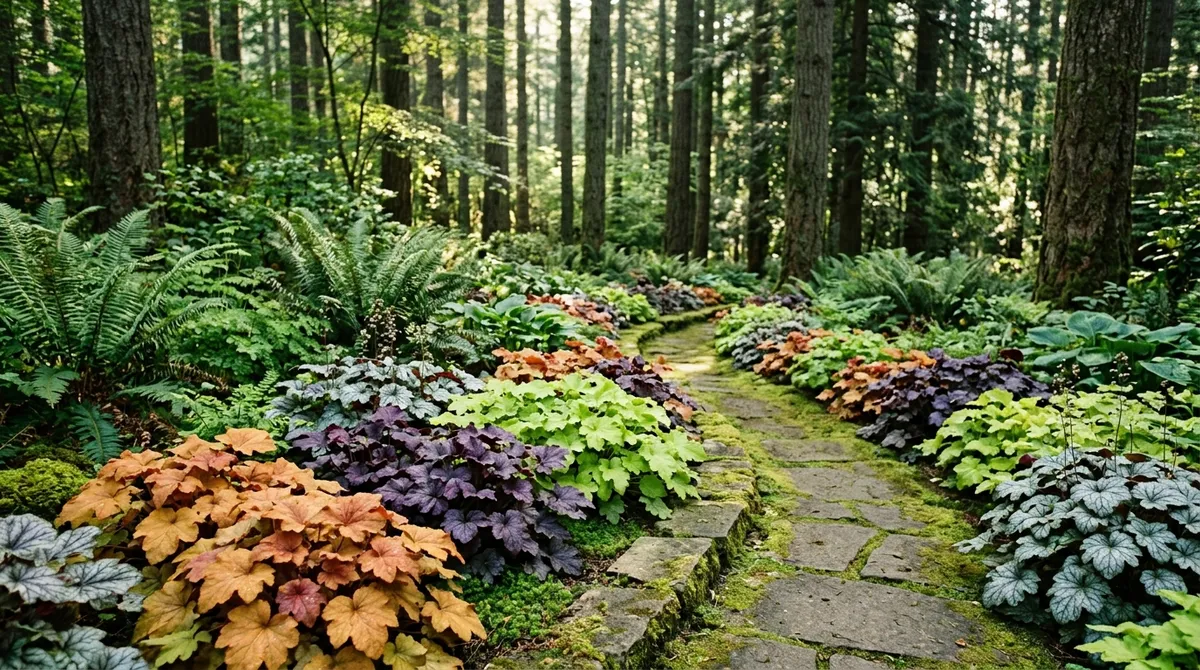
Why coral bells earn a spot in every shade garden
Coral bells (Heuchera) are the workhorse of the shaded American garden. They hold their color from March through November in mild zones, attract hummingbirds in early summer, and pair with almost any companion plant from hostas to hardy ferns. Most cultivars stay tidy at 8-18 inches tall and rarely outgrow their spot. I have trialed 22 named varieties in my Zone 8a Portland beds over six seasons, and the right ones return reliably for five years or longer.
The trick is treating Heuchera as a foliage plant first and a flowering plant second. The leaves carry the show for nine months of the year. The flowers are a six-week bonus.
What coral bells are and where they come from
Heuchera is a genus of about 50 species, all native to North America. The straight species grow wild from the Pacific Northwest to the Appalachians, with notable natives including Heuchera americana (alumroot) from the Eastern US, Heuchera sanguinea (the original coral bells) from the Southwest, and Heuchera villosa (hairy alumroot) from the Southeast. Most modern garden cultivars are hybrids that blend traits from these three species.
The common name comes from the small bell-shaped flowers carried on wiry spikes 12-30 inches above the foliage. Native species mostly produce coral-red flowers, which gave the genus its old-fashioned name. Modern breeding has pushed flower colors into white, pink, and deep red, but the real revolution has been in foliage.
According to the Missouri Botanical Garden, Heuchera cultivars now exist in nearly every leaf color except blue and true black, with silvers, purples, ambers, and limes dominating the modern catalog.
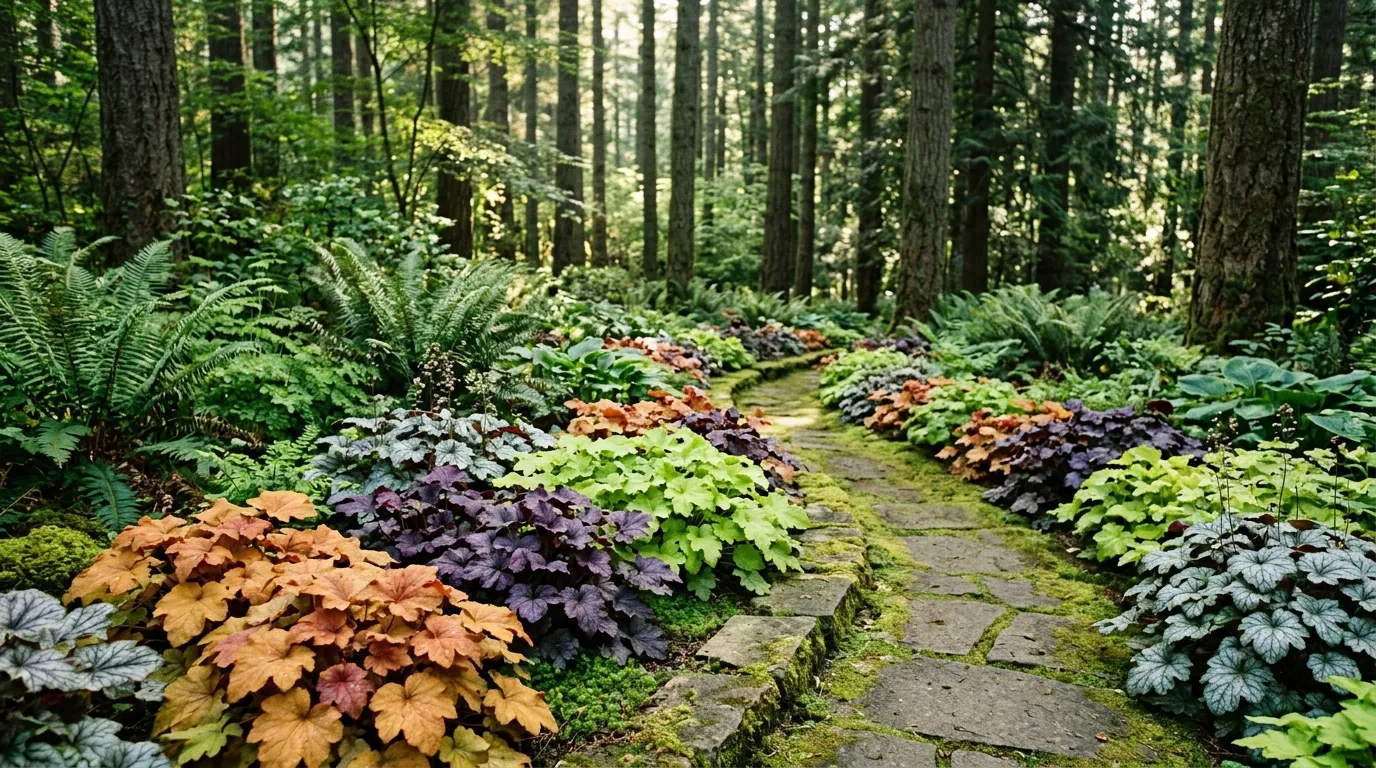 A mixed coral bells planting in my Portland front border, photographed in late May.
USDA zone hardiness and where they thrive
Most coral bells are hardy from USDA Zone 3 to Zone 9, though individual cultivars vary at the extremes. Hybrids with Heuchera villosa blood tend to handle Southern heat better and stay evergreen into Zone 9. Hybrids with stronger Heuchera americana parentage perform best in colder Zone 3-5 gardens.
In the cooler half of the country (Zones 3-6), coral bells stay green and active longer, sometimes well into December under a cover of snow. In the South (Zones 7-9), they slow down during the hottest weeks of August but rarely go fully dormant. In my Zone 8a Portland garden, I see active leaf growth from February through November.
If you garden in Zone 10 or hotter, coral bells become summer-stressed and are usually treated as cool-season plants or grown in shade with afternoon misting. The University of Florida extension recommends treating them as annuals south of Zone 9b.
A foliage color tour of the best cultivars
The fastest way to understand modern coral bells is to look at the color range. I have grown every cultivar in the table below and noted which ones earned a permanent spot in my beds.
| Cultivar | Foliage Color | Height | Flower Color | USDA Zones | Light | Sarah’s Notes |
|---|---|---|---|---|---|---|
| ’Marmalade’ | Amber-orange to copper | 8-10 in | Cream | 4-9 | Part shade | Best amber I have grown. Holds color through summer. |
| ‘Cherry Cola’ | Cherry red to bronze | 8-10 in | Red | 4-9 | Part shade | Slow but bombproof in heat and humidity. |
| ‘Forever Purple’ | Glossy deep purple | 10-14 in | Pink | 4-9 | Part shade | Most reliable purple in my trial. Vigorous. |
| ‘Silver Gumdrop’ | Silver with green veins | 8-10 in | Pink | 4-9 | Part shade | Lights up dark corners. Needs sharp drainage. |
| ‘Lime Marmalade’ | Chartreuse lime | 8-10 in | Cream | 4-9 | Part shade | Brightest lime, scorches in afternoon sun. |
| ‘Caramel’ | Caramel to peach | 12-16 in | Pink | 4-9 | Sun to part shade | My top pick for hot zones. Takes more sun. |
| ‘Obsidian’ | Near-black purple | 10-12 in | White | 4-9 | Part shade | Looks dramatic against silver hostas. |
| ‘Berry Smoothie’ | Pink to plum | 14-18 in | Pink | 4-9 | Part shade | Color shifts through the seasons. |
| ‘Palace Purple’ | Bronze-purple | 12-18 in | White | 4-9 | Sun to part shade | The classic. Cheapest, easiest, still good. |
| ‘Citronelle’ | Bright lime gold | 8-12 in | Cream | 4-9 | Part shade | Holds color in heat better than ‘Lime Marmalade’. |
Expect to pay $14-22 for a 1-gallon plant at a general nursery and $22-32 for the newest patented cultivars at a specialty perennial grower. Online mail-order plants in 4-inch pots run $9-14 each but take an extra year to size up.
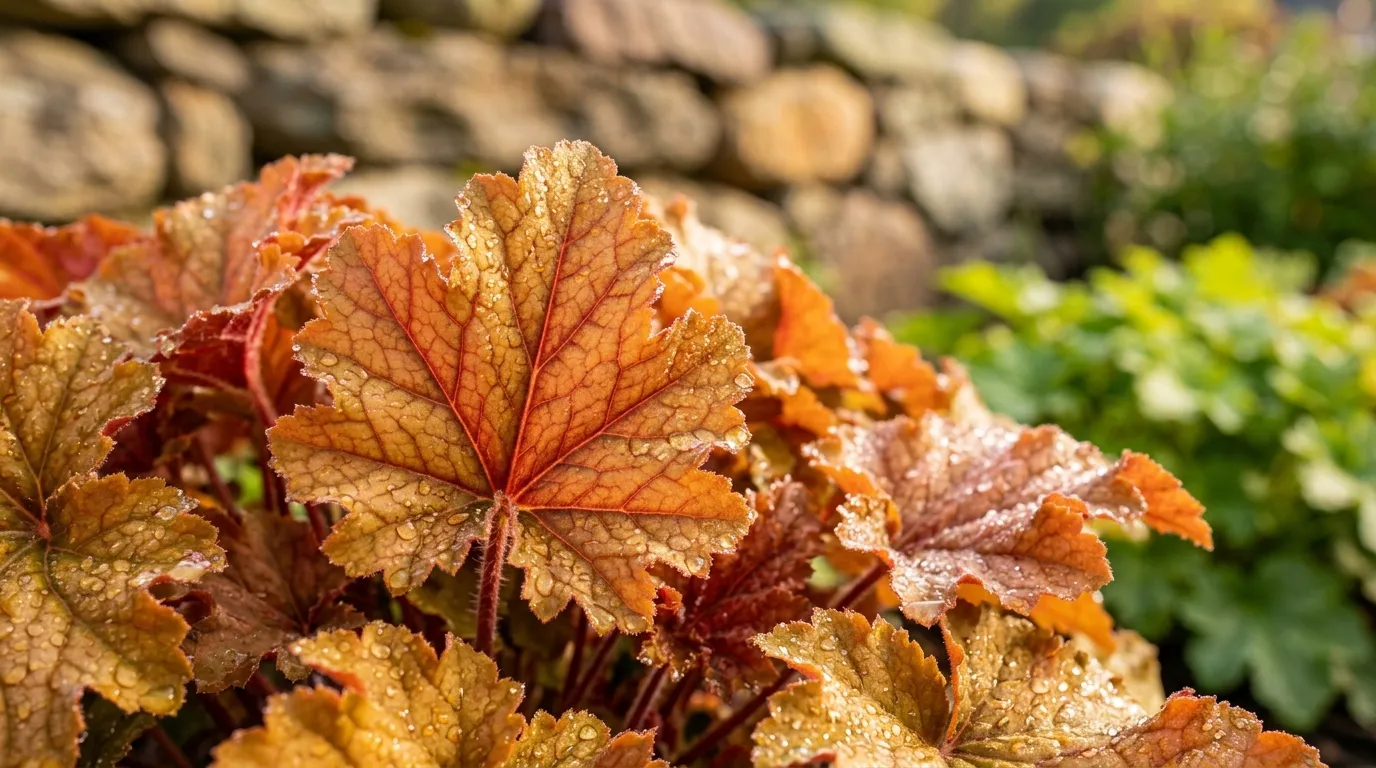 Heuchera ‘Marmalade’ holds its amber color from spring through fall in my Portland trial.
Light needs by region
Coral bells live in a confusing spot in most light charts. They are usually labeled “part shade,” but the right amount of sun depends entirely on your climate.
Cool zones (USDA 3-5): Most cultivars take full sun if the soil holds moisture. Plants grown in full sun produce stronger color, more flower spikes, and tighter mounds. Six hours of direct sun is fine in Minneapolis or Buffalo.
Mid zones (USDA 6-7): Aim for 4-5 hours of morning sun and afternoon shade. The morning light deepens leaf color while the afternoon shade keeps leaves from scorching. This is the sweet spot for most Heuchera in the Mid-Atlantic and Midwest.
Warm zones (USDA 8-9): Stick to 2-4 hours of gentle morning light, then full shade by noon. Heavy clay reflective surfaces (pavement, white walls) bake leaves even in shade, so site coral bells back from the house or driveway. The Chicago Botanic Garden recommends bright open shade under high tree canopies as the best siting in warmer Midwest gardens.
Dark-leaved cultivars (‘Forever Purple’, ‘Obsidian’, ‘Cherry Cola’) tolerate more sun than light-leaved types. Silvers and limes scorch first.
Soil drainage is the make-or-break factor
The single biggest reason coral bells fail in American gardens is poor drainage. They evolved on rocky slopes, woodland edges, and gravelly seeps where water moves through the soil quickly. Heavy wet clay rots their crowns within a single winter.
You can grow great coral bells in nearly any soil if you fix the drainage. Here is what works in my Portland beds, where the underlying soil is sticky silt loam that holds water for weeks.
Build the bed up. Raise the planting area 4-6 inches above the surrounding grade. Even a small mound sheds water during the wet months.
Add grit, not compost. Compost retains water. Coarse pumice, expanded shale, or horticultural grit (not playground sand) opens up the soil and creates drainage channels. I mix one third pumice into the top 8 inches of my Heuchera beds.
Avoid mulch piled against the crown. A 2-inch layer of bark mulch is fine for the wider bed, but keep mulch pulled back at least 2 inches from the woody crown. Mulch against the stem traps moisture and invites rot.
Test by watering. After installation, pour a gallon of water on the bed. If it ponds on the surface for more than 30 seconds, add more grit before planting.
The soil pH is less critical. Coral bells grow well from pH 6.0 to 7.5 and tolerate the slightly acidic soils common across much of the US.
Why I recommend ‘Caramel’ for hot zones
After six seasons of trialing 22 cultivars, ‘Caramel’ is the one I recommend to every gardener south of Zone 7. It carries strong Heuchera villosa parentage, which gives it the heat tolerance most modern hybrids lack.
In my Portland trial bed, ‘Caramel’ survived a stretch where the bed hit 96°F for six straight days in June 2024 with no leaf scorch. The same week killed two ‘Silver Gumdrop’ plants outright and burned the edges off three ‘Lime Marmalade’ clumps. ‘Caramel’ also takes more sun than most cultivars, comfortably handling 5-6 hours of morning light in my garden.
The foliage color shifts through the season. Spring growth emerges peach-pink, deepens to caramel-amber in summer, and turns bronze by October. The flower spikes are pink-white and reach 24 inches tall. At maturity, a single plant covers a 16-18 inch circle, making it one of the larger Heuchera available.
If you garden in Zone 8 or 9, plant ‘Caramel’ first and add the showier cultivars once you trust the location.
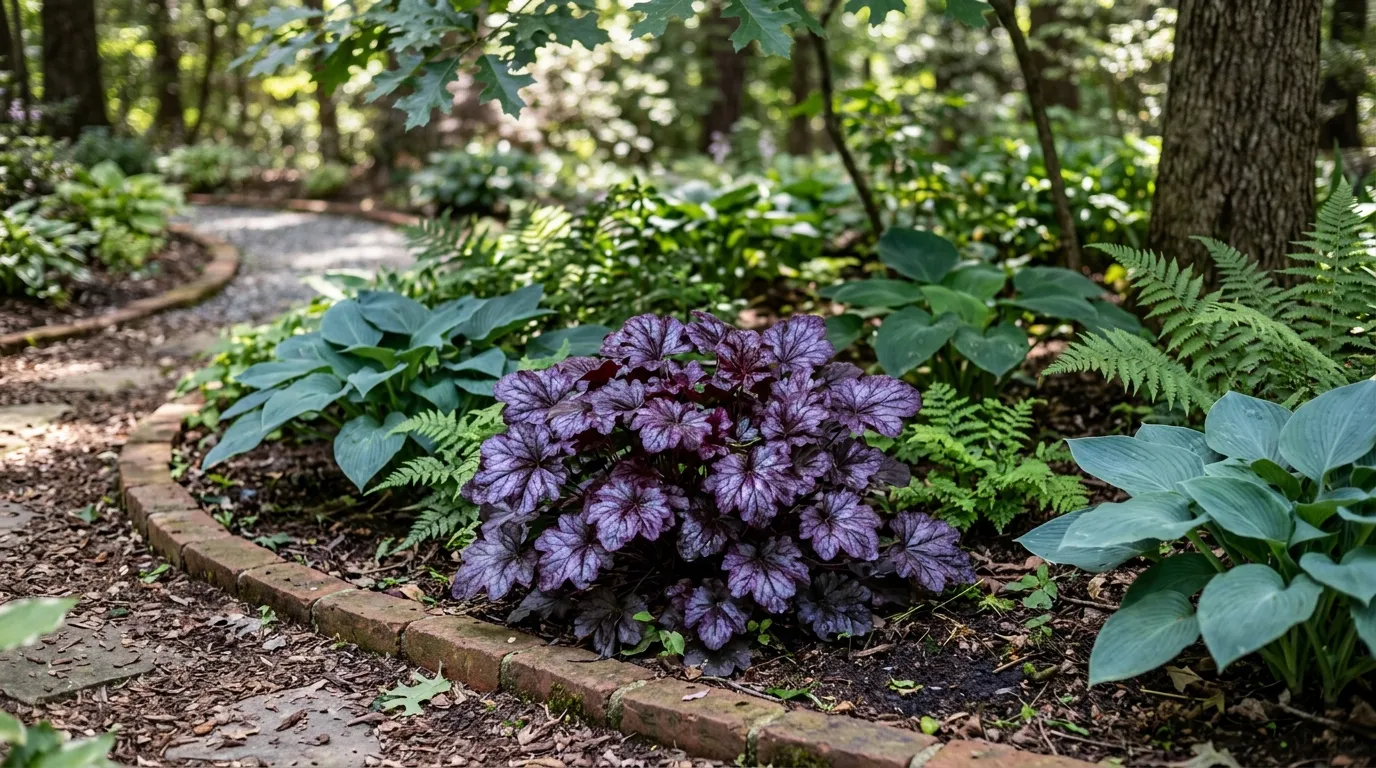 ‘Forever Purple’ is the most reliable dark-leaved cultivar I have grown.
Watering rules for the first year and beyond
Coral bells have shallow root systems for the first two years. They need consistent moisture during establishment but cannot sit in wet soil. The balance trips up a lot of new growers.
First growing season: Water deeply once a week, soaking the root zone to 8 inches deep. In hot dry weather (90°F-plus or wind), water twice a week. Use your finger to check soil moisture an inch down before adding more water.
Established plants (year 2 and beyond): Water deeply every 10-14 days in dry weather. Most US gardens get enough natural rainfall through spring and fall to skip supplemental watering entirely. Established Heuchera tolerate 2-3 weeks of dry soil without permanent damage.
Avoid overhead watering. Wet leaves invite powdery mildew and bacterial leaf spot. Use drip irrigation or hand-water at the base of the plant.
Watch for wilt early in the morning. If leaves are wilted before 9 a.m., the plant needs water. Afternoon wilt during a heatwave is normal and corrects itself overnight.
How to divide coral bells and why you must
The single most important maintenance task for coral bells is regular division. Heuchera crowns grow upward each season, lifting the plant out of the ground over time. After 3 years, you will see woody crown tissue exposed above the soil with bare roots underneath. After 4 years, the center of the clump usually dies.
Divide every 3-4 years to refresh the planting, extend the plant’s lifespan, and produce free plants for the rest of the garden.
When to divide: Early spring (March-April in most zones) as new growth emerges. Fall division (September) also works in Zones 6 and warmer.
How to divide:
- Dig the entire clump with a garden fork, lifting from 6 inches outside the foliage to capture the root mass.
- Shake off loose soil and rinse the crown with a hose to expose the woody base.
- Use a sharp knife or pruning shears to cut the crown into sections, each with 3-5 healthy shoots and a chunk of root.
- Discard the dead center.
- Replant each section with the crown 1 inch below the soil surface (deeper than the original planting). This buries the lifted woody stem and forces new roots from the base.
- Water deeply and mulch lightly.
A mature 4-year-old clump usually yields 3-4 strong divisions. Pot up extras to give away or move into other beds.
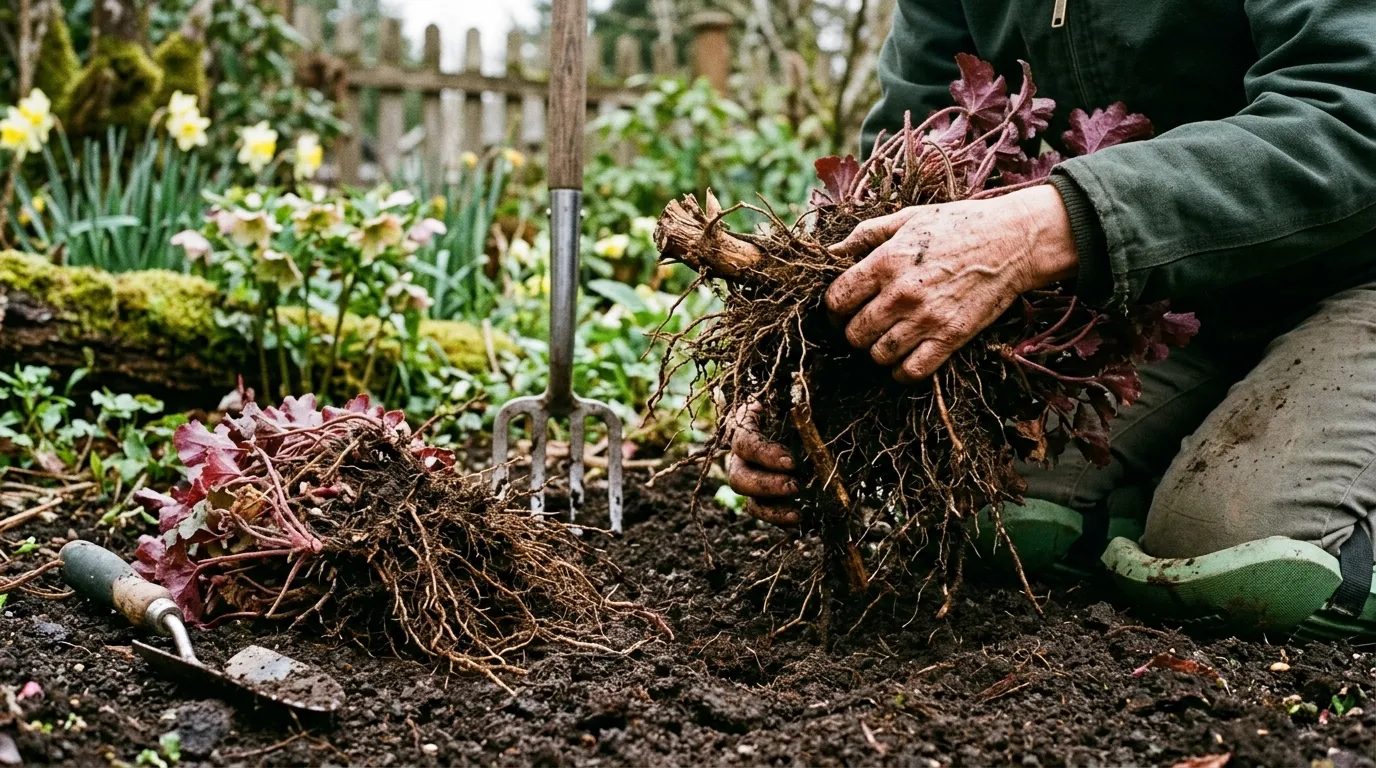 Spring division in my Portland garden. Each section gets replanted 1 inch deeper than the original crown.
Month-by-month care calendar
This is the calendar I follow in my Zone 8a garden. Shift it forward 4-6 weeks for Zones 3-5 and back 2-3 weeks for Zones 9-10.
| Month | Task |
|---|---|
| January | Inspect mulch, push back from crowns. Order spring divisions if needed. |
| February | Tidy any winter-damaged leaves with clean shears. Top-dress with 1 inch of compost around (not on) crowns. |
| March | Divide overgrown clumps. Plant new 1-gallon containers. |
| April | Watch for heuchera weevil notching on leaves. Apply slow-release fertilizer at half rate. |
| May | Flower spikes emerge. Stake taller cultivars in windy spots. |
| June | Peak hummingbird visits. Deadhead spent spikes by cutting at the base. |
| July | Water deeply in hot dry stretches. Mulch refresh if needed. |
| August | Monitor for crown rot in wet years. Lift and re-grade any sinking plants. |
| September | Best fall planting window opens. Divide if not done in spring. |
| October | Stop feeding. Allow plants to harden off naturally. |
| November | Apply winter mulch (2 inches) once soil temperature drops below 40°F. |
| December | Plants stay evergreen in mild zones; cut back any black damaged leaves. |
Pest and disease watch
Coral bells are mostly trouble-free, but three problems show up often enough to warrant attention.
Heuchera weevil (black vine weevil): The most common pest. Adults notch the leaf edges in spring (chew marks shaped like half-moons), and larvae feed on roots underground. Heavy larval feeding can sever roots and kill plants. Apply beneficial nematodes (Heterorhabditis bacteriophora) to the soil in May and September when soil is above 55°F. This is the most effective organic control.
Crown rot (Pythium and Rhizoctonia): Caused by waterlogged soil and crowns buried too deep. The plant looks wilted even after watering, leaves yellow and collapse, and the base of the stem turns black and mushy. There is no chemical cure. Lift the plant, cut away rotted tissue, and replant in better-drained soil. Prevention is the only real fix.
Powdery mildew: Appears as a white dusty coating on leaves in humid weather. Improve air circulation by spacing plants 12-18 inches apart and avoiding overhead watering. A mild infection rarely kills the plant; cut affected leaves at the base and discard.
Common mistakes new growers make
These are the five mistakes I see most often, in roughly the order I made them myself.
Planting too deep. The crown should sit at or just above the soil surface. Burying the crown causes immediate rot in wet soils. The exception is during division, when you intentionally plant deeper to bury the lifted stem.
Skipping division. A coral bells clump left undivided for 5-6 years declines fast. The center dies, the edges flop, and the woody crown rises 2 inches out of the soil. Divide every 3-4 years to keep plants young.
Full sun in the South. A label that reads “full sun to part shade” was written for the Upper Midwest. In Zone 8 or 9, full afternoon sun bleaches leaf color in a single afternoon. Site coral bells where they get morning sun only.
Heavy compost-rich soil. Compost holds water, and coral bells hate wet feet. Use grit and pumice to improve drainage instead of piling on amendments. A leaner soil with good drainage outperforms a richer wet soil every time.
Watering the foliage. Overhead sprinklers wet the leaves and invite mildew. Water at the base with a watering can or drip line.
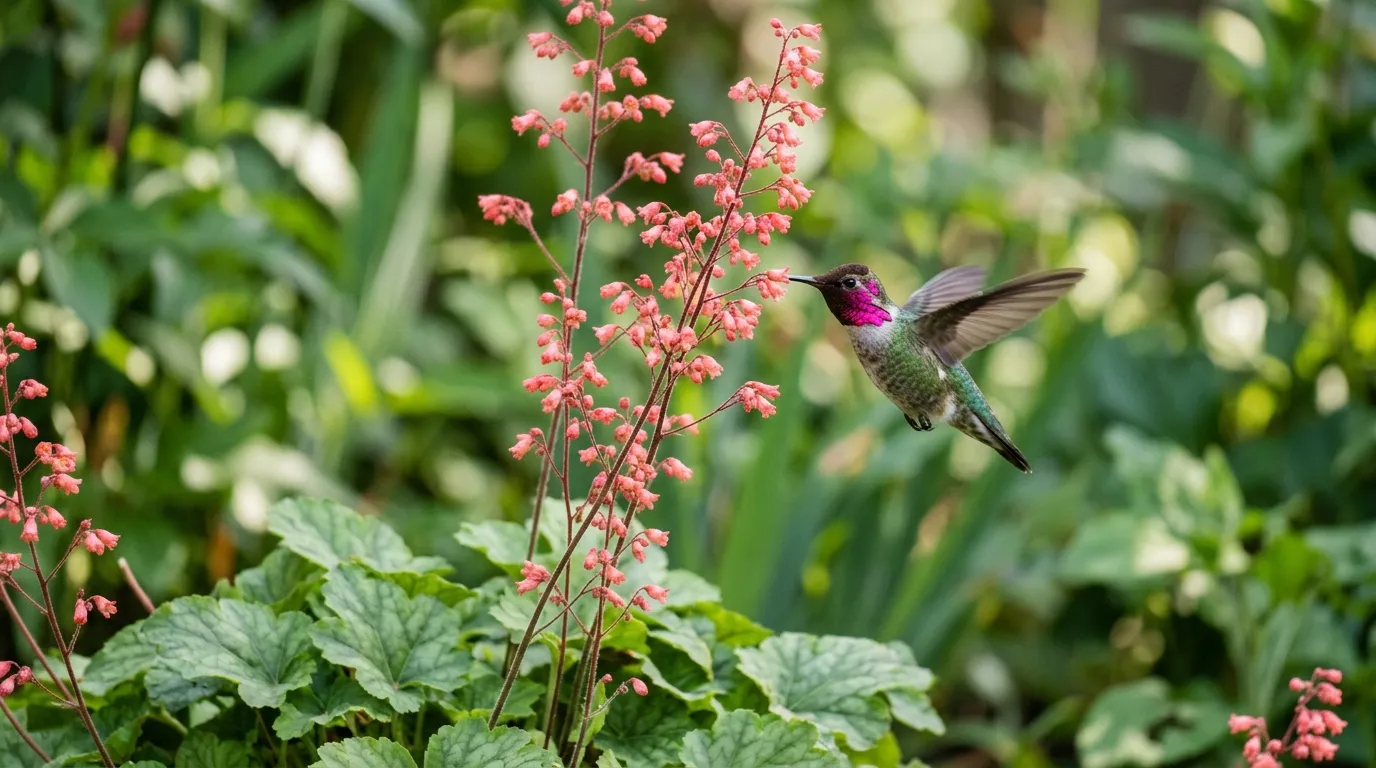 Anna’s hummingbird at a coral bells flower spike in my Portland garden, late May.
Companion plants that work in any shade bed
Coral bells pair well with nearly every classic shade-garden plant. Aim for contrast in leaf shape and color. A purple Heuchera looks twice as rich next to a chartreuse hosta, and a silver Heuchera glows against a deep green fern.
Hostas: The classic shade pairing. Use a small or medium hosta to balance the smaller scale of Heuchera. Try ‘Blue Mouse Ears’ hosta with ‘Marmalade’ coral bells.
Hardy ferns: Japanese painted fern (Athyrium niponicum ‘Pictum’) is a perfect partner. The silver and burgundy fronds echo the colors found in Heuchera leaves.
Brunnera: The blue forget-me-not flowers and silver leaves of ‘Jack Frost’ brunnera pair beautifully with purple coral bells.
Heucherella and Tiarella: Foamy bells (Heucherella) and foamflower (Tiarella) are close cousins of Heuchera and share the same growing requirements. They make natural companion plantings.
Spring bulbs: Daffodils, scilla, and grape hyacinths bloom while coral bells are pushing fresh growth, then fade as the Heuchera takes over the display.
If you are layering a shade bed from scratch, build it around foliage contrast first and flowers second. The result holds interest for nine months a year instead of two weeks of bloom and ten months of green.
For more ideas on long-blooming partners, see our spring perennials guide. To pull pollinators to the bed, attract pollinators to your garden covers the plants and structures that pair well with shade beds. If you are gardening on a patio or balcony instead, container gardening for small spaces walks through the pot sizes and soil mixes that suit coral bells in containers.
Get started with coral bells this season
If you have a partly shaded spot with decent drainage, pick three contrasting Heuchera cultivars this weekend and plant them in a 3-foot triangle. I would suggest ‘Forever Purple’ for depth, ‘Marmalade’ for warmth, and ‘Silver Gumdrop’ for brightness. Within two seasons you will have a glowing shade vignette that holds color from March through November.
Buy 1-gallon plants from a regional perennial grower if you can find one. The plants establish faster and survive their first winter with better root reserves than mail-order plugs. Whatever you choose, get the drainage right first and the rest takes care of itself.
Sarah Mitchell is a Master Gardener and garden writer based in the Pacific Northwest. She has been growing food and flowers for over 15 years across USDA zones 7 and 8.